Best Solar Pond Aerators for Farm Ponds
Answer: For farm ponds, solar-powered aerators provide reliable oxygenation with minimal running costs and reduced electrical risk. The best options below target different pond sizes, climates, and budgets. Choose this if you need daytime solar charging with battery backup, choose that if you want compact portability, and avoid options with insufficient run-time in cloudy conditions. The following picks are among the most relevant for farm-use, balancing solar efficiency, battery support, and diffuser reliability.
| Product | Best For | Why It Stands Out |
|---|---|---|
| DC HOUSE 5.76CFM Solar Pond Aerator | Medium to large farm ponds | High airflow, integrated lithium battery, robust diffuser design |
| POPOSOAP 15W Solar Pond Aerator | Small to medium ponds, day-night use | 3 modes, built-in battery, efficient solar cells |
| POPOSOAP 8W Solar Pond Aerator | Small ponds or tanks | Dual power, 3 modes, compact |
| Srygery Solar Pond Aerator | Small to medium ponds, DIY installations | Independent panel, three modes, battery |
| Lewisia 30W Solar Pond Aerator | Medium to large ponds requiring stronger airflow | Timer control, higher airflow options |
DC HOUSE 5.76CFM Solar Pond Aerator

The DC HOUSE unit combines a 300W pump with a 5.76CFM output and a 400W lithium battery system. It ships with four 100W solar panels and 100′ of weighted tubing, plus improved anti-floating diffusers for stable performance. Best for buyers needing strong daytime pumping with solid battery support for off-peak hours. This model is better for mid-to-large ponds where consistent aeration is critical. A potential limitation is the heavier hardware and higher upfront setup required for installation.
POPOSOAP 15W Solar Pond Aerator

This 15W model provides three modes (strong, soft, cycle) and includes a 4400mAh battery. It is best for small to medium ponds where daytime solar charging is reliable but budget matters. It excels in flexible aeration patterns and night-time oxygenation, which helps maintain water quality on overcast days. A limitation is its moderate airflow compared with larger units, so it may be less ideal for larger ponds or high flow requirements.
POPOSOAP 8W Solar Pond Aerator

With 8W of solar power and a built-in 4400mAh battery, this option supports 24/7 aeration with three modes. It is best for very small ponds or tanks where space is limited and a discreet, portable solution is preferred. It’s a solid pick for hobby farms or seasonal installations. The trade-off is lower maximum airflow compared with higher-watt models, which may limit oxygen transfer in warmer conditions.
Srygery Solar Pond Aerator

The Srygery model uses an independent solar panel connected to the pump, minimizing wiring complexity and improving solar conversion. It offers three modes and a built-in battery, making it suitable for farms where outdoor wiring is less desirable. Best for: small to medium ponds that require straightforward, reliable daytime operation with supplemental night-time aeration. Limitation: some users report shorter battery life in consistently low sunlight climates.
Lewisia 30W Solar Pond Aerator
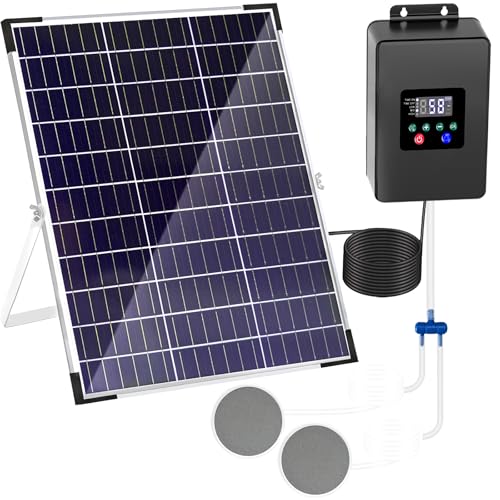
The Lewisia system includes a 30W solar panel and timer-controlled air pump, delivering higher airflow for larger ponds while enabling scheduled operation. Best for farms needing predictable, timed aeration to coordinate with feeding and maintenance schedules. The main caveat is that the timer functionality may require careful setup to align with daily workflow.
Buying Guide: Solar Pond Aerators For Farm Ponds
How to choose by pond size and airflow
Assess pond volume and desired dissolved oxygen levels. Higher CFMs are preferred for larger ponds or warmer climates. For small farm paddocks, compact units with 2–8W panels may suffice, while larger livestock ponds benefit from 15W–30W systems or multi-panel kits.
Battery backup vs. grid-free operation
Battery-backed models allow aeration during cloudy days or at night, ensuring continuous oxygenation. Solar-only units rely on sun’s availability; they are best in sunny regions or with frequent maintenance windows for daytime operation. Consider battery lifespan and charge-discharge cycles when evaluating longevity.
Diffuser design and durability
Anti-floating or anti-corrosion bases help maintain stable diffuser placement. Dense diffuser holes create finer bubbles for more efficient oxygen transfer. Explosion-proof diffuser panels can reduce crack-prone failures in harsh environments.
Maintenance and installation considerations
Look for models with straightforward assembly, clear tubing length, and robust seals. Heavier kits with multiple panels require secure mounting and accessible maintenance access. For DIY setups on farms, independent solar panels with sealed connections minimize risk from weather and dust.
Price vs. value for farm use
Higher wattage and larger panel arrays increase upfront cost but extend run-time and reliability in off-peak periods. For seasonal farms, mid-range models with battery backup often strike a balance between cost and dependable aeration.
FAQ
- Do I need a battery with a solar pond aerator for a farm pond? Battery backup is recommended if aeration is needed at night or during cloudy days to maintain water quality.
- What size pond can a 15W solar aerator handle? It generally suits small to medium ponds; for larger ponds, higher-wattage units or multiple units may be necessary.
- Can these systems be moved between ponds? Yes, most models are portable, especially those with independent panels and compact pumps.
- What maintenance is required? Regularly inspect tubing, diffusers, and seals; clean panels occasionally and ensure battery connections are secure.
- Are solar aerators safe for livestock and pets? Yes, most are designed for outdoor use with sealed electrical components and low voltage operation.
- What is the best choice for a large farm pond? A higher wattage system with multiple panels, robust diffuser setup, and battery backup tends to perform best in larger volumes.